

The books / Scientists & Inventors
Isaac Newton
The Man Who Found the Rules
Isaac Newton split sunlight into a rainbow, built a new kind of telescope, and found the rules for how everything moves, from a falling apple to the moon. Kids color 18 scenes from his life, each paired with a short, easy page about what really happened.
- Ages 6 to 10
- 40 pages, 8.5 × 11 in
- 18 scenes to color
- Paperback, printed on one side
What readers say
★★★★★
This is a fantastic coloring book that deserves a perfect 5-star rating! "Coloring History's Isaac Newton" is a brilliant, highly engaging, and fun way to introduce science and history to kids and teens. Learning about gravity and the rules of the universe through creative coloring is an excellent concept.
Everything about this book is flawless. The technical execution is top-notch—the lines are crisp, perfectly clear, and beautifully defined. The scenes are well-thought-out, deeply interesting, and perfectly balanced. It is an exceptionally professional and educational tool that makes learning an absolute joy.
He watched an apple fall and wondered if the same pull reached the moon.
Who was Isaac Newton?
Isaac Newton was born on Christmas Day in 1642, in a stone farmhouse called Woolsthorpe Manor in the east of England. (England used an older calendar then. On today's calendar, his birthday was January 4, 1643.) He grew up to be a mathematician and scientist who explained how things move, why things fall, and what light is made of. Many people call him one of the most important scientists who ever lived.
A tiny baby on a farm
Isaac's father, a farmer also named Isaac, died about three months before he was born. Baby Isaac was born early and was so small that his mother, Hannah, later said he could have fit inside a quart mug. When he was three, his mother remarried and moved to a nearby village, and Isaac stayed at the farm with his grandmother. He was a quiet boy who liked to make things with his hands: a little windmill that really worked, clocks, and sundials to tell time by the sun.
School, sheep, and Cambridge
At about age 12, Isaac went to school in the town of Grantham. He lived with a man named William Clarke, who made and sold medicines, and he read every book he could find. When Isaac was a teenager, his mother brought him home to run the farm. It did not go well. He read books while the sheep wandered off. His uncle and his old schoolmaster talked his mother into sending him back to school, and in 1661 he went to Trinity College at Cambridge University. A few years later, he became a professor there.
The plague years
In 1665, a terrible sickness called the plague spread across England, and the university closed. Isaac went home to the farm for about a year and a half, and he did some of his best thinking ever. He worked on a new kind of math, now called calculus. He shined sunlight through a glass prism and showed that white light is really a mix of all the colors of the rainbow. Late in his life, Isaac told a friend that seeing an apple fall in the garden at Woolsthorpe got him thinking about gravity. (There is no evidence it hit him on the head.) He wondered whether the same pull that brought the apple down could reach all the way to the moon.
The rules of motion
In 1668, Isaac built a new kind of telescope that used a curved mirror instead of glass lenses, so it showed stars clearly without blurry rainbow edges. Scientists at the Royal Society in London loved it and made him a member. In 1684, the astronomer Edmond Halley asked Isaac how planets move. Isaac said he had already worked it out. Halley urged him to write it all down and even paid to print the book. It came out in 1687 and is known as the Principia. In it, Isaac set out his three laws of motion and showed that the same pull of gravity that drops an apple also keeps the moon going around the Earth and the planets going around the Sun.
Keeper of the coins
In 1696, Isaac moved to London to work at the Royal Mint, where England made its money. Some people cheated by shaving bits of silver off coins or making fake ones, and Isaac tracked them down. He later ran the whole Mint and became president of the Royal Society. He also had a long, bitter argument with a German thinker named Gottfried Leibniz over who invented calculus first. Today, historians agree that each man worked it out on his own.
What we kept
Isaac Newton died in London in 1727, at age 84, and he was buried in Westminster Abbey. His three laws of motion are still the rules engineers use to plan the paths of rockets and spacecraft. Many of the biggest telescopes in the world use curved mirrors, like his did. Scientists even named a unit of force the newton in his honor. Every kid who drops something and wonders why it falls down, not up, is asking Isaac's question.
What's in the book
The 18 coloring scenes follow his life in order: Born on a Farm, Little Builder, School in Grantham, Off to Cambridge, The Plague Year, Sunlight Splits, An Apple Falls, The Apple and the Moon, A New Telescope, The Royal Society, A Friend Asked, He Wrote the Rules, Three Rules of Motion, Honest Coins, Hard Days, What We Kept.
- A pronunciation page
- A map of Newton's England
- His three rules of motion, in words kids can understand
- A "What We Kept" page on the ideas we still use
- An "I Colored History" certificate
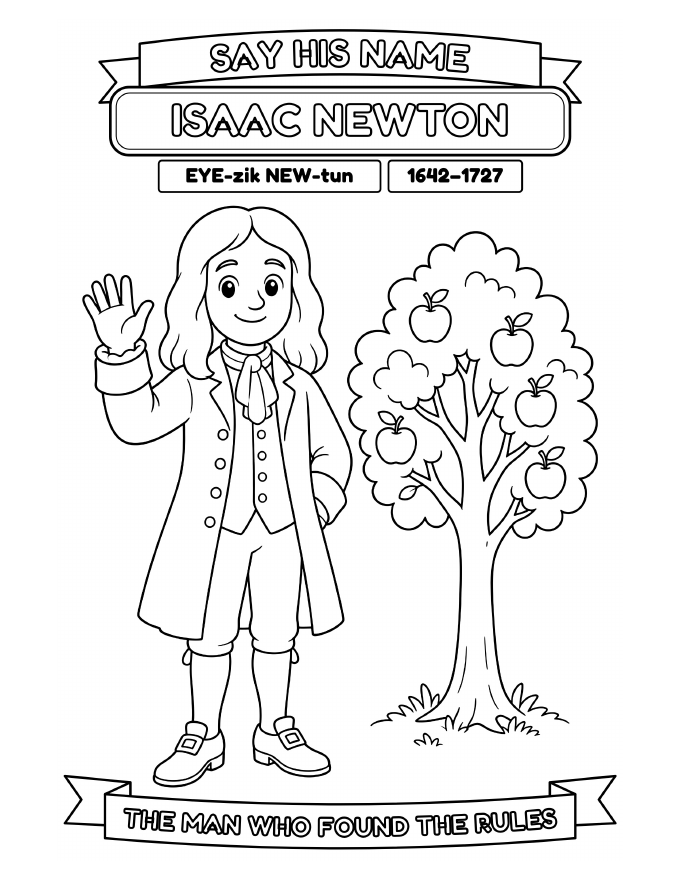
Free Isaac Newton coloring page
This is the first coloring page from the book, with his name, how to say it, and the years he lived. Print it on regular letter paper. It is free for home and classroom use.
Download the PDFWant the other 17 scenes? Order the book for $9.99.


